

Is Gold a Good Long-Term Investment?
Gold is often grouped among “alternative” investments to stocks and bonds, and it tends to attract the most attention when economic uncertainty is high. Frequently described as a safe haven, an inflation hedge, or a portfolio diversifier, gold is thought to offer protection during periods of market stress or economic downturns. Some investors even view it as its own distinct asset class, arguing that its currency-like characteristics can provide stability during extreme events such as global financial crises, geopolitical shocks, or episodes of rapid inflation.
But do these perceived benefits hold up over the long term—and does gold deserve a place in a long-term investment strategy?
Does Gold Deliver as Promised?
Though often seen as a safe haven, gold’s history tells a different story. Historically, gold has experienced much higher price volatility than that of the S&P 500 stock index while delivering a substantially lower return.
The chart below depicts what percent the price of gold has been off its most recent high at a given point in time. A value of zero means that gold is at or breaking new highs while a value below zero represents a drawdown. Gold has not only experienced many sharp short-term declines, but it has also endured two significant drawdowns that each took many years to recover from.
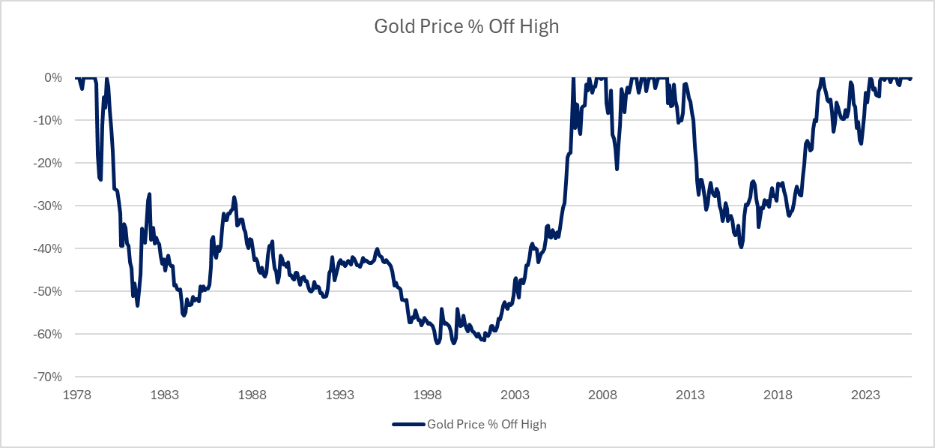
If you bought gold in October of 1979, you would have had to wait almost 27 years— until May 2006—before gold returned to your original purchase price. Throughout that 27-year period, you would have endured a max decline of 62% while watching both the US economy and stock market grow.
As the next chart shows, gold has even struggled to keep pace with the much lower risk/more stable U.S. bond market (Bloomberg U.S. Aggregate Bond Index).
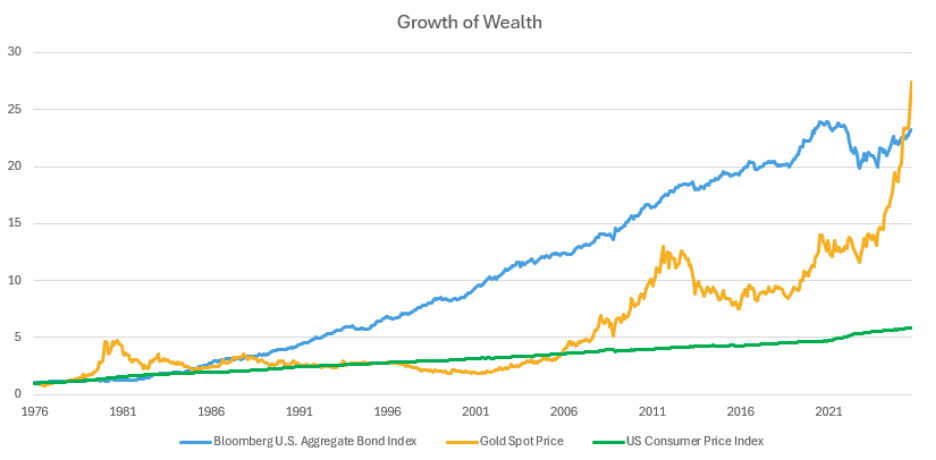
Unlike bonds, gold does not generate income, and its return relies almost entirely on changes in investor sentiment rather than contractual cash flows. As a result, gold’s performance during periods of uncertainty has been inconsistent, limiting its effectiveness as a dependable defensive asset.
Not a Great Short-Term Inflation Hedge
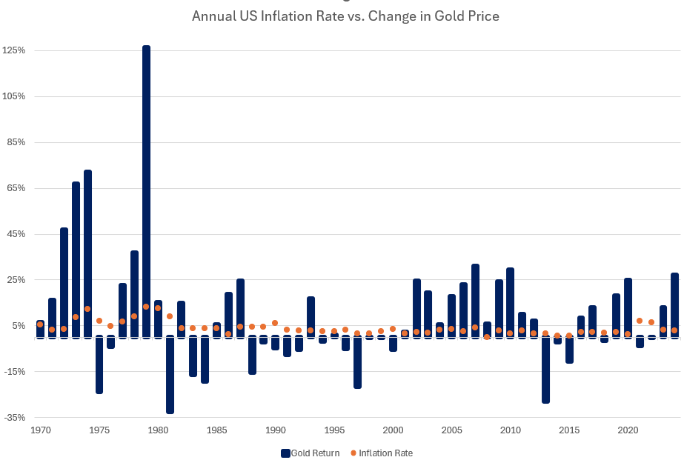
Gold’s short-term price fluctuations are often extreme relative to inflation. The sometimes extreme differences between gold’s return and the prevailing inflation rate prove that it is an inconsistent hedge to short-term inflation; as seen in the chart below, gold has underperformed inflation in 42% (23 of 55) of calendar years from 1970-2024. Making matters worse, gold underperformed inflation by an average of 12.88% in those 23 years. Gold also didn’t come to the rescue in high inflation years like 2021 and 2022—where inflation averaged 6.75%, but gold prices were down in both years.
Is Diversification Enough to Include Gold in Your Portfolio?
Financial principles should ultimately guide any investment decision—this means having economic rationale rooted in logic and portfolio theory. Principles of modern finance suggest the primary components of a diversified portfolio should have an expected return which is derived from the value investors place on projected future cash flows from the investments. Since gold neither pays a dividend nor generates cash flow, there is no basis for calculating an expected return.
It is this fact that led widely respected Vanguard founder John Bogle to state: “Commodities don’t belong in anybody’s portfolio at any time for any reason. It is a total speculation. You can make money by speculating, and someone else will lose. Look at gold—with no internal rate of return, it has not matched Treasury Bill performance. It is not investing, it is a gamble.”
Uncertainty and risk can be frightening, but it’s a fact of life that investors must accept. Modern finance teaches us that the risks worth taking are those that carry an expected return. With stocks and bonds, investors put their money to work in the capital economy. These investments help power enterprises that generate growth and productivity—this is what earns expected return. Commodities like gold don’t create economic growth. As Bogle indicates, “investing” in gold is speculation: you hope the price will go up but have no real reason to expect it to over the long-term.
The price of gold is primarily driven by investor psychology. For better or worse, when uncertainty is high, gold becomes heavily marketed as a solution to that uncertainty. And now, with the advent of exchange traded funds tracking gold, it has become much easier for individuals to invest (often chasing performance) in the precious commodity.
While there is no denying that gold has periodically delivered attractive returns, investors must recognize that it has also experienced tremendous price declines resulting in flat or even negative returns for periods of twenty years or more. We instead believe in the merits of a diversified portfolio to combat market volatility and inflation over the long run. For long-term investors, a well-constructed portfolio of stocks and bonds remains the most reliable way to participate in economic growth and build wealth over time.